
History is often written in the boardrooms of large coastal cities or on distant battlefields.
But for the families living in Dover, New Philadelphia, and Sugarcreek in the mid-1940s, history was being written right in their own utility closets.
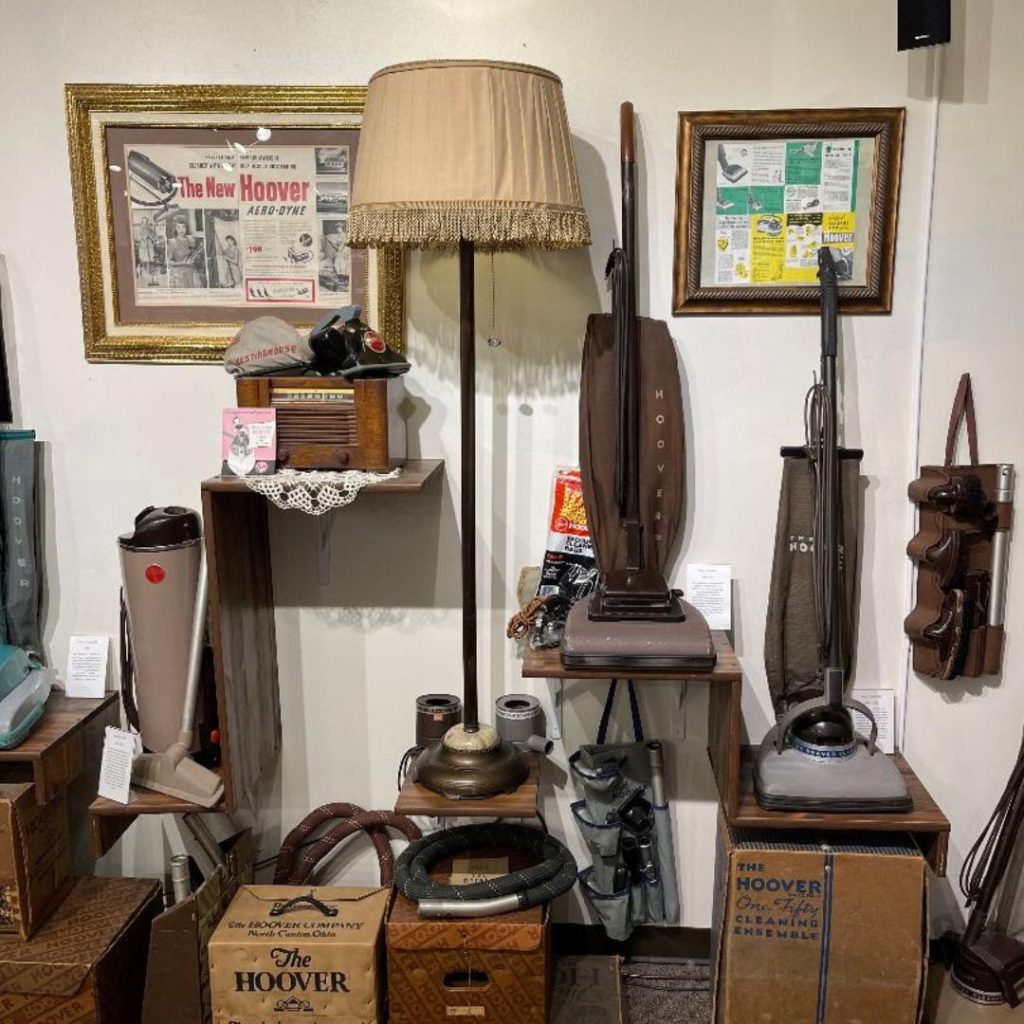
At John’s Sweeper Service, we are obsessed with the “why” behind the machines we fix every day. When you step into our Vintage Vacuum Museum in downtown Dover, you can physically see the moment the world changed.
The 1940s were a decade of incredible, rapid transition. As the manufacturing power of the United States shifted away from wartime production and back toward the domestic home, a revolution in appliance design took place.
It was an era where “Speed” became a design language. It was the decade where a simple piece of paper solved the most disgusting chore in the house.
Today, we are looking at the 1940s: the decade of post-war innovation and the birth of the modern, streamlined sweeper.
The End of the War and the “Domestic Boom”
In the early 1940s, vacuum production in America essentially ground to a halt.
The War Production Board ordered civilian appliance manufacturing to stop so that raw materials like aluminum, rubber, and copper could be diverted to the front lines.
Companies like Hoover and Eureka shifted their factories almost overnight. Instead of floor polishers and uprights, they were producing high-tech airplane parts, parachutes, and precision instruments for the war effort.
If you were a housewife in T-County in 1943 and your sweeper broke, you couldn’t just go buy a new one.
You had to keep your machine running with bits of string, electrical tape, and sheer willpower. This created a massive backlog of demand for new technology.
When the war ended in 1945, veterans were returning home to Strasburg and Bolivar, starting families, and moving into new “suburban” houses.
They wanted appliances that didn’t just work—they wanted machines that represented the optimism and the “New Frontier” of a post-war era.
The Aerodynamic Aesthetic: Mimicking the Zephyr
If you look at the vacuum cleaners from the 1920s and 30s, they look like what they are: industrial tools. They are boxy, heavy, and strictly functional.
But in the late 1940s, a new design movement called Streamline Moderne took over the American living room.
Designers were obsessed with aerodynamics. Even if a machine was intended to stay stationary or move slowly, it was designed to look like it was traveling at 100 miles per hour.
They were inspired by the legendary Burlington Zephyr, the stainless-steel, “bullet-shaped” diesel train that had recently shattered speed records.
As noted by historical archives at American-Rails, the Zephyr’s streamlined look defined the concept of modern speed for an entire generation.
Chrome, Curves, and Speed
Manufacturers began designing vacuums to look like they were ready to take flight.
- Chrome and Curves: Vacuums suddenly featured rounded, bullet-shaped motor housings and gleaming chrome accents. These weren’t just for show; they represented the cleanliness and “sanitary” nature of the new atomic age.
- Integrated Headlights: Many 1940s models began including high-intensity headlights. These were designed to look like the nose of a streamlined locomotive, illuminating the dust under heavy furniture.
- The Sled Design: Canister vacuums moved away from heavy, clunky wheels and toward smooth, stainless-steel runners (sleds). This allowed them to glide across T-County rugs with effortless grace, much like a sled on snow.
These machines were no longer just tools; they were pieces of industrial art.
According to design records at the Smithsonian Institution, this era marked the first time that “lifestyle” and “aesthetics” became just as important as “suction” in the American marketplace.
The Dirty Secret of the Cloth Bag
While the chrome and curves were exciting, the true innovation of the 1940s was a direct response to the “dirty secret” of cleaning history.
For the first forty years of vacuum history, cleaning the machine was arguably more disgusting than the dirt itself.
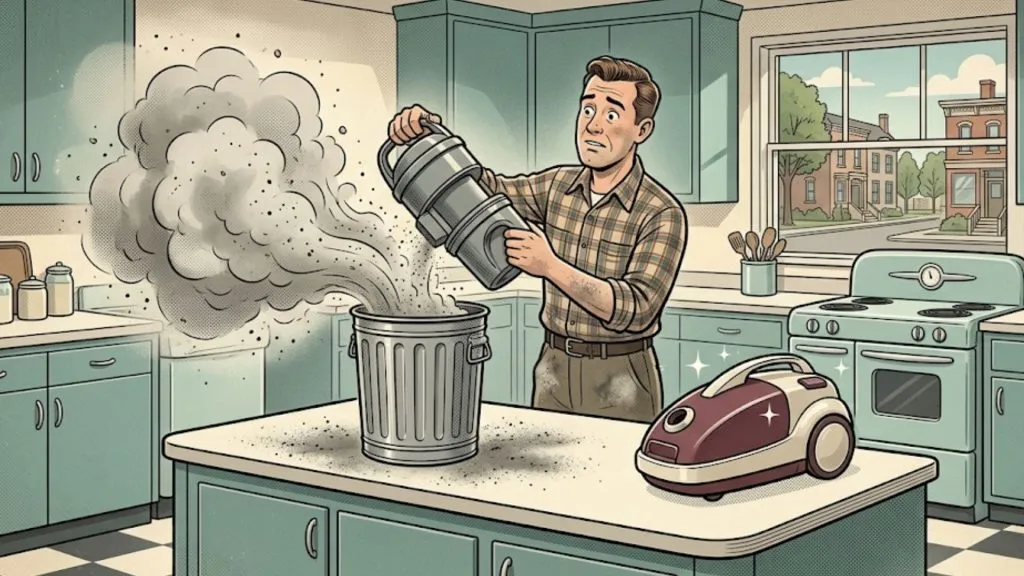
All vacuums used a permanent, heavy cloth bag. There were no liners.
When the bag was full, you had to take the vacuum out to the backyard, the garage, or the alleyway behind your Dover shop.
You had to unzip the bag and physically shake the thick, black cloud of coal soot, pet hair, and floor dust out into the open air.
The “Soot Cloud” Nightmare
If the wind caught that bag while you were shaking it, you would be covered in the very dirt you just spent an hour trying to remove.
It was a dusty, allergic, and deeply unpleasant chore that housewives absolutely loathed. It was also incredibly unsanitary.
Because you could never get 100% of the dust out of the fabric pores, these cloth bags eventually began to smell musty and stale, especially in the humid Ohio summers.
The Greatest Relief: The Invention of the Disposable Paper Bag
In the late 1940s, the “Paper Bag Revolution” arrived, and it was marketed as a miracle.
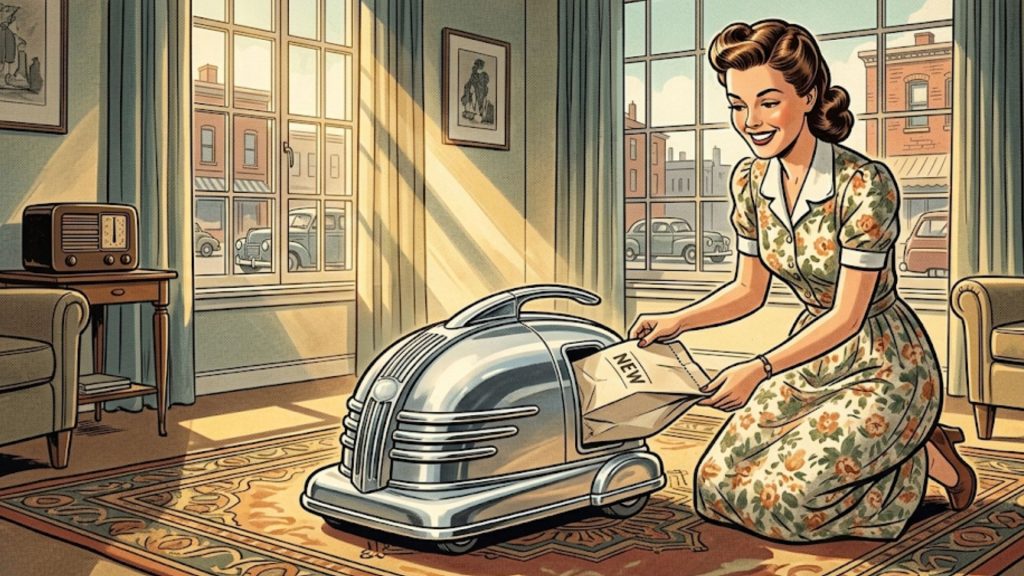
Manufacturers finally introduced the removable, disposable paper dust bag.
It is hard to overstate how much of a game-changer this was for the T-County housewife.
Instead of shaking out a filthy cloth bag, you simply opened the vacuum, pulled out a neat paper liner, and tossed it into the trash.
A Revolution in Hygiene and Air Quality
This single innovation did more to improve indoor air quality and household hygiene than almost any other advancement in appliance history.
It meant that the dirt stayed trapped, the allergens stayed locked away, and the homeowner stayed clean.
It was a symbol of post-war luxury—the ability to simply throw away the mess and move on with your day.
This allowed the vacuum to maintain much higher suction power for longer periods, as the fresh paper pores allowed the motor to “breathe” far better than an old, caked-up cloth bag.
For a deeper look at how modern bags continue this legacy, see our comprehensive guide to vacuum bags.
Spotlighting the 1940s Legends in Our Museum
If you tour our museum in downtown Dover today, you will see the “All-Stars” of this era. These machines were built with an incredible level of quality that we rarely see in the big-box stores today.
The Electrolux Model XXX (Model 30)
Perhaps the most iconic machine of the 1940s, the Model XXX was a masterpiece of Streamline Moderne design.
With its polished chrome end-caps and smooth, sled-like runners, it looked like it was designed by a rocket scientist.
It was quiet, powerful, and built so well that we still have customers bring them in for professional residential repair today—over 80 years later!
The Model XXX was the first to truly perfect the “fully sealed” system, ensuring that no dust escaped the canister before it hit the filter.
The Kirby Model G and 505
Kirby continued their tradition of die-cast aluminum power in the 1940s. These machines were virtually indestructible.
While they were heavier than the Electrolux sleds, they offered the best carpet agitation in the world.
They were the “workhorses” that many families in New Philadelphia relied on for decades.
A 1940s Kirby was an investment that often cost as much as a used car, and the quality of the metal castings reflected that price tag.
The Hoover “61”
Hoover refined their “Triple Action” cleaning system in the 40s. These uprights were the first to truly embrace the integrated look.
The headlight, the motor housing, and the handle were designed to flow together into a single, cohesive shape.
It was during this era that Hoover truly perfected the “beating” brush roll, ensuring that even the heaviest T-County rugs were cleaned deep into the base.
The 1940s “Buy It For Life” Philosophy
One of the most profound lessons we can learn from the 1940s is the commitment to longevity.
During the war, people learned the value of a machine that could be repaired. When parts were scarce, you fixed what you had.
Post-war manufacturers initially carried this philosophy into their new designs.
These machines weren’t designed to be thrown away after three years. They were held together with heavy-duty metal screws, not glue or plastic clips.
The motors used thick copper windings that could be refurbished by a local mechanic.
According to research from the Hagley Library, the 1940s represented a peak in “serviceable design,” where products were built to be maintained by the owner or a local craftsman.
This is the exact same philosophy we look for today when we select the machines for our showroom. We believe your vacuum should be a long-term partner in your home, not a disposable item.
Evidence of a Broken (1940s) Sweeper
When you are dealing with a machine that is nearly a century old, the troubleshooting steps are very specific.
Old metal vacuums are incredibly robust, but they have unique vulnerabilities—especially regarding their original electrical systems.
If you are a collector or you’ve inherited a classic family heirloom, watch out for these signs of trouble. Here is our quick-reference table for 1940s-era sweeper issues:
| The Warning Sign | What the Evidence Means | DIY Skill Level | Your Next Step |
| Cracking, Stiff Power Cord | The original rubber and cloth insulation has dry-rotted, exposing live copper. | Professional | Do not plug in! The cord must be completely replaced for safety. |
| A “Dusty” Smell When Running | The secondary cloth bag has lost its seal, or the paper liner is torn. | Beginner | Check the internal seals and replace the bag immediately. |
| High-Pitched Bearing Squeal | The 80-year-old motor grease has dried into a solid, causing metal-on-metal friction. | Advanced | Turn it off! Bring it to the shop to have the motor lubricated. |
| Dimming or Flickering Headlight | Motor vibration has loosened the vintage socket or the bulb is failing. | Beginner | Inspect the wiring connections and replace the bulb. |
| Vibration That Moves the Vacuum | The metal or wooden fan has a chipped blade, throwing the motor out of balance. | Professional | This requires an expert teardown to replace the fan. |
If you encounter any of these issues, don’t give up on the machine. These are “Buy It For Life” appliances, and they were designed to be rebuilt.
Troubleshooting Guide for the 1940s Sweeper
Whether you are a beginner or an advanced DIYer, here is how you can tackle some of these classic repairs.
Beginner DIY: The Paper Bag Fit
Many owners of 1940s machines struggle with finding modern paper bags that fit.
- The Seal Check: Ensure the cardboard collar of the new bag is seated perfectly flush against the intake port.
- The “Snug” Test: If the bag is too loose, air will bypass the bag and coat the inside of your motor with dust. You may need to use a small piece of weather-stripping foam to create a tighter seal for a modern bag in an old machine.
Advanced DIY: Inspecting the Carbon Brushes
If your 1940s motor is running slowly or “pulsing,” your carbon brushes are likely worn down.
- Locate the Brushes: Most 1940s motors have two screw-on caps on the side of the motor housing.
- The Measurement: Unscrew the caps and pull out the spring-loaded carbon block. If the block is less than 1/4 inch long, it’s time to replace it.
- The Contact: Use a piece of very fine sandpaper to clean the copper commutator before installing new brushes to ensure a smooth electrical contact.
Fun Facts: 5 Pieces of 1940s Sweeper Trivia
We love talking history with our visitors in Dover! Here are a few of our favorite facts from the post-war era.
- 1. The “Tank” Nickname: During the 1940s, people didn’t call them “canister vacuums.” They called them “Tank Vacuums.” This was because their long, cylindrical shape and heavy-duty metal construction reminded people of the military tanks they saw in the newsreels.
- 2. Door-to-Door Sales: In the late 40s, the vacuum salesman was a celebrity in T-County neighborhoods. He would often show up with a pristine, chrome Electrolux and perform “magic tricks,” like using the vacuum exhaust to spray paint or even blow up air mattresses!
- 3. The “Light Fixture” Legacy: While most homes had wall outlets by the 1940s, many T-County farmhouses still used old “pigtail” adapters to plug their sweepers into ceiling light sockets—a lingering habit from the Edison era.
- 4. Wartime Wooden Parts: In very late 1941 and early 1942, some vacuums were built with wooden handles and plastic baseplates to save aluminum for the war effort. These “wartime models” are now incredibly rare collector’s items.
- 5. The $100 Prize: In 1948, a high-end Electrolux could cost nearly $100. When you consider that the average weekly wage, according to Library of Congress records, was about $40, buying a vacuum was a massive financial commitment for a local family.
The Importance of Professional Vintage Care
Restoring a 1940s vacuum is about more than just making it look pretty. It is about preserving a piece of American industrial history.
When you bring a vintage machine to John’s Sweeper Service, we don’t just “fix it.” We treat it with the respect it deserves.
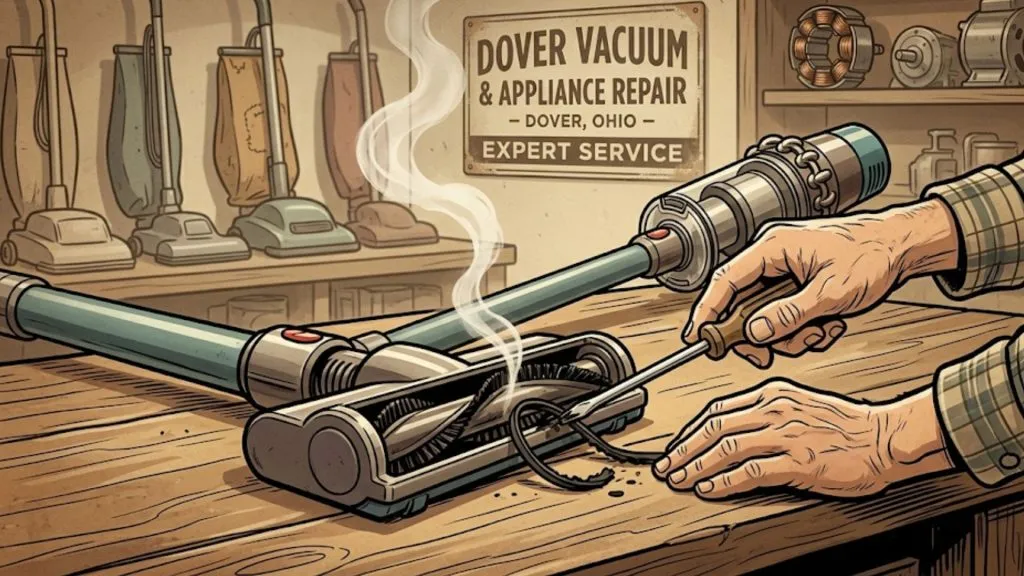
We check the integrity of the motor windings, we replace dangerous, antiquated wiring, and we source authentic parts that match the original specifications.
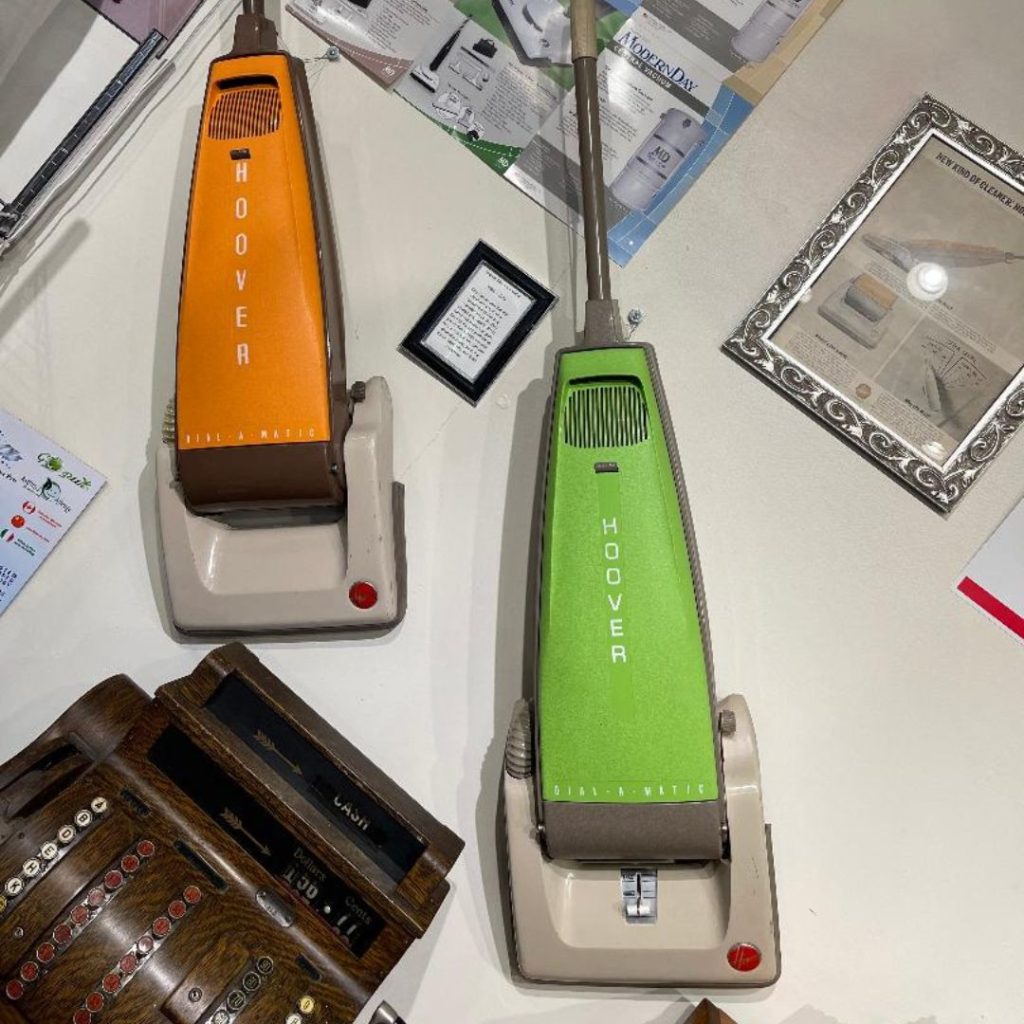
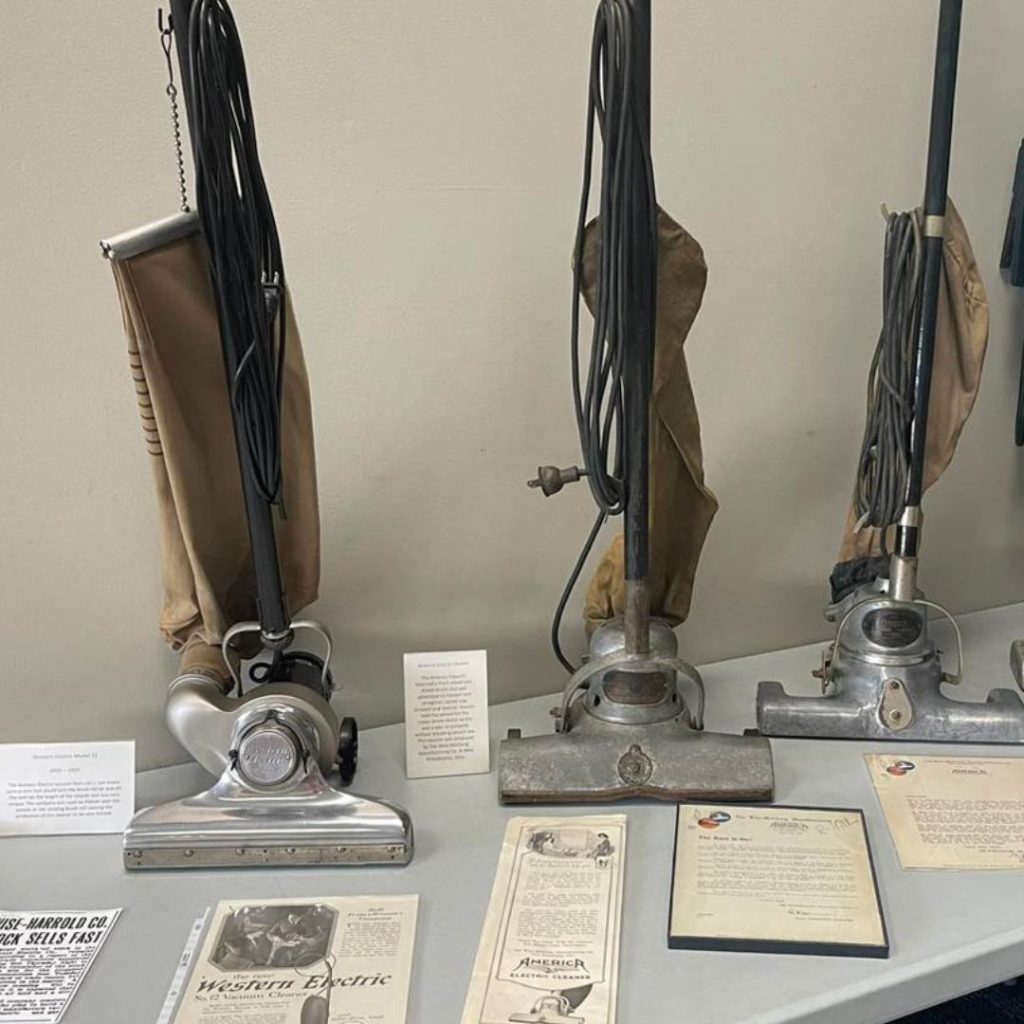
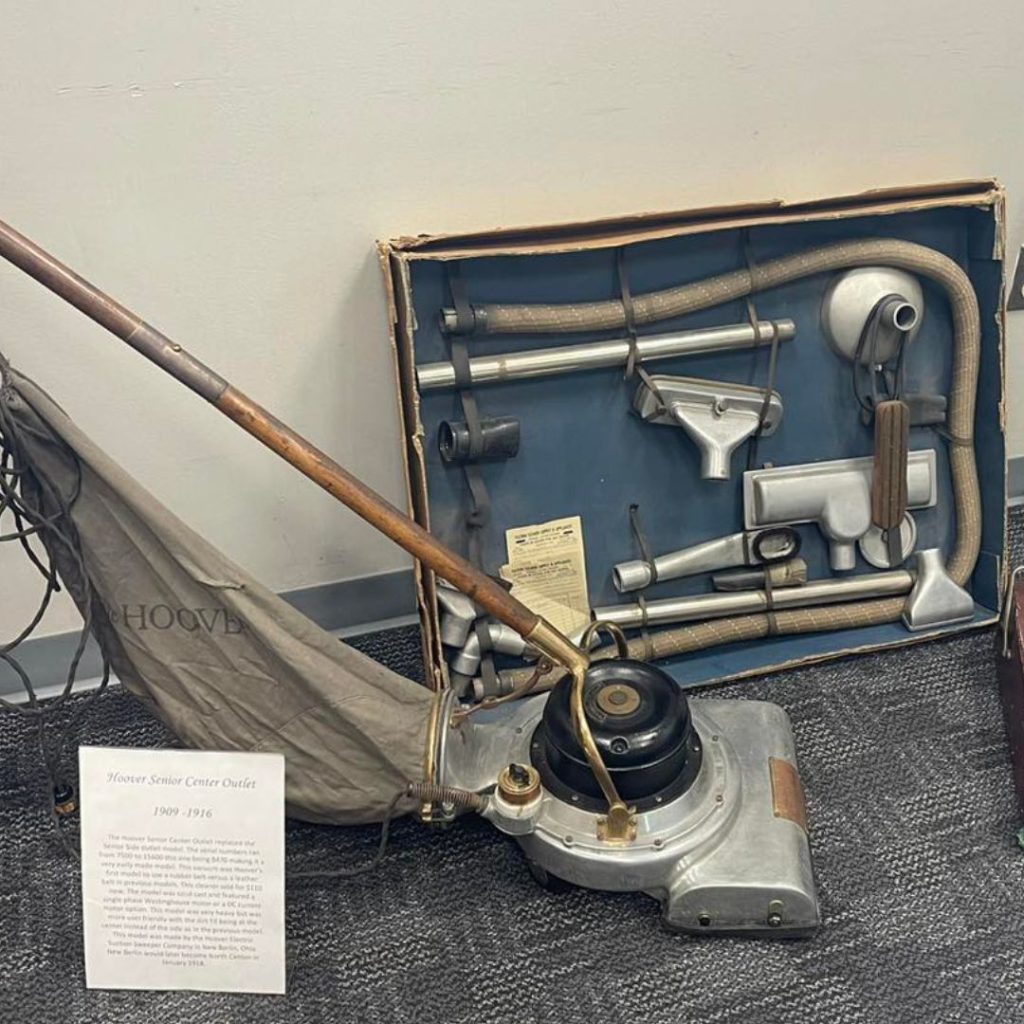
Experience the Revolution in Downtown Dover!
You don’t just have to read about these streamlined marvels; you can see them, hear them, and even touch them right here in T-County.
We invite you to visit our storefront and take a walk through John’s Vintage Vacuum Museum.
Come see the gleaming chrome of the 1940s for yourself. Marvel at the “rocket ship” designs that paved the way for the technology we use today. It is a nostalgic, educational experience that celebrates the ingenuity of the American home.
While you are here, let us help you with your modern cleaning needs, too. Whether you need a fresh pack of bags for your new SEBO or a professional repair for your old Hoover, we provide the kind of honest, neighborly service that has made us a Dover staple for decades.
Don’t settle for a disposable machine when you can own a piece of history. Visit John’s Sweeper Service and our Vintage Vacuum Museum in Dover today!
Related reading: The Electric Sweeper Revolution: How Ohio and Edison Changed Your Home Forever | Museum Spotlight: The 1950s Hoover Constellation and the “Space Age” Sweeper