
If you have ever visited our storefront in downtown Dover, you know we are passionate about the history of cleaning technology.
We love helping our Tuscarawas County neighbors fix their modern machines, but our true pride and joy sits right in the center of our shop.
Our storefront is home to John’s Vintage Vacuum Museum.
We have spent decades curating a massive collection of antique vacuums in Dover OH, preserving the incredible mechanical history of the American home.
When visitors walk through our museum doors, they are immediately struck by how drastically appliance design has changed over the last century.
Of all the classic vacuum cleaners in our museum collection, there is one particular model that absolutely always stops people in their tracks.
It doesn’t look like a traditional upright sweeper. It doesn’t look like a standard heavy metal “tank.”
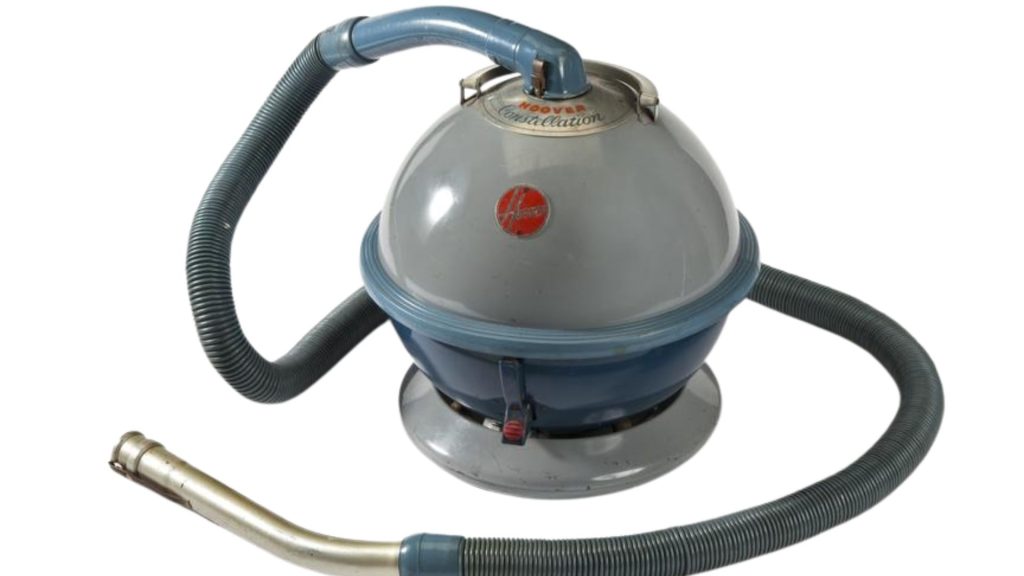
Instead, it looks like a small, pastel-colored spacecraft that somehow crash-landed onto a living room rug.
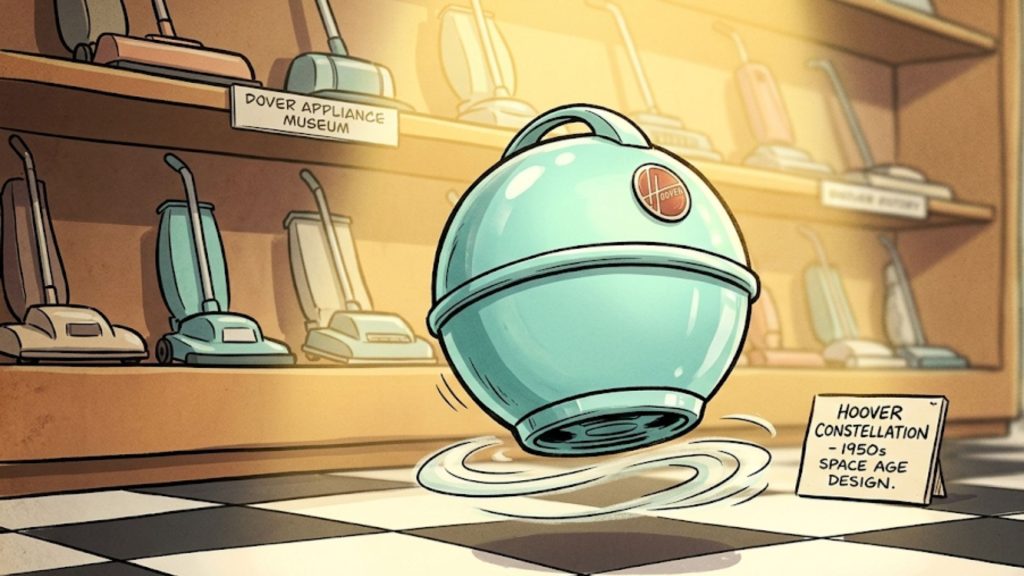
We are talking about the legendary Hoover Constellation vacuum cleaner.
Introduced in the mid-1950s, this spherical marvel represents one of the most daring, imaginative, and downright bizarre chapters in vacuum cleaner history.
Today, we are going to dive deep into the fascinating story of the 1950s floating vacuum cleaner, how it worked, and why it ultimately faded into history.
The Post-War Boom and the Space Age Aesthetic
To truly understand the Hoover Constellation, you have to understand the era in which it was born.
In the years following World War II, America was experiencing an unprecedented economic and cultural boom.
Families in New Philadelphia and Sugarcreek were moving out of older farmhouses and into newly built suburban homes equipped with modern conveniences.
There was a profound, undeniable sense of optimism sweeping across the country. Science and technology were advancing at a staggering pace.
By the mid-1950s, the “Space Race” was beginning to completely capture the public’s imagination.
As historians at NASA frequently note, the national obsession with rockets, satellites, and the cosmos began to heavily influence everyday consumer culture.
Automobiles were suddenly being designed with massive rocket tailfins and chrome bullet bumpers. Kitchen appliances featured gleaming chrome dials that looked exactly like spaceship control panels.
Vacuum cleaners were certainly no exception to this cultural shift.
For decades, vacuums had been strictly utilitarian objects. They were heavy, cast-iron beasts built to do a dirty job, and they were quickly hidden in the closet when company came over.
But in the 1950s, homeowners wanted appliances that were sleek, modern, and futuristic.
The Hoover Company, historically based right here in our own Ohio backyard, decided it was time to completely reinvent the wheel.
Quite literally, they decided to get rid of the wheels altogether.
The Mid-Century Modern Home: Appliances as Showpieces
Before we look at the engineering, we have to look at the spectacular design of the Constellation.
During the 1950s, the aesthetics of the home were changing rapidly. The dark, heavy woodwork of the Victorian and Craftsman eras was being replaced by the bright, airy look of Mid-Century Modern design.
Kitchens and living spaces were suddenly bursting with color.
Appliance manufacturers realized that they no longer had to make vacuums in boring industrial gray or standard black. The Hoover Constellation was specifically designed to be a beautiful object.
It was a machine you didn’t have to hide.
Hoover released the Constellation in a series of stunning, highly polished pastel colors. You could purchase the floating sphere in “Larkspur Blue,” a soft “Pearlescent Pink,” or a vibrant Mint Green.
These colors were specifically chosen so the housewife could perfectly match her vacuum cleaner to her pastel kitchen countertops or her brightly colored living room drapes.
It was a brilliant marketing strategy that turned a chore into an incredibly stylish endeavor.
Engineering the Floating Vacuum Cleaner
While the colors were beautiful, the true magic of the Constellation lay in its radical mechanical engineering.
When you look at standard 1950s vacuum cleaner models, they are almost exclusively long, heavy metal cylinders. You had to drag these heavy tanks across the floor on metal runners or small, squeaky wheels.
They were notoriously difficult to maneuver. They frequently flipped over if you pulled the hose too sharply, spilling a cloud of dust everywhere.
Hoover engineers wanted to design a canister vacuum that was completely, effortlessly mobile.
They came up with a brilliant, highly unconventional solution based squarely on the physics of a hovercraft.
The Hoover Constellation was designed as a perfect, futuristic sphere.
Instead of putting traditional wheels on the bottom of this sphere, Hoover engineered a specialized, complex base plate.
This base plate was designed to channel the powerful exhaust air from the electric motor directly underneath the machine.
Walking on Air (Without Making a Mess)
In a traditional vacuum, the dirty air you suck in through the hose is filtered and then blown directly out the back of the machine.
In the Hoover Constellation, that massive volume of exhaust air was forced downward through a narrow ring at the very bottom of the base.
When you turned the machine on, this high-pressure exhaust created a powerful, invisible cushion of air between the bottom of the vacuum and the floor.
The entire vacuum cleaner literally lifted off the ground and hovered!
It floated effortlessly across the room like a puck on an air hockey table. The user simply pulled gently on the flexible hose, and the spherical vacuum glided seamlessly behind them without the friction of wheels.
But you might be wondering: wouldn’t blowing high-pressure air at the floor just scatter dust everywhere?
Hoover engineers thought of that. They designed a highly efficient double-filtration system.
The air was pushed through a thick paper bag, and then through a secondary cloth filter. By the time the air exited the bottom of the machine to create the “hover” effect, it was incredibly clean. It lifted the machine without kicking up dirt.
It was a brilliant piece of mechanical engineering that felt like absolute magic to a 1950s consumer.
Fun Facts: 4 Pieces of Constellation Trivia
Before we discuss the downfall of this incredible machine, let’s share some of our favorite historical trivia. We love sharing these fun facts with guests who tour our museum collection!
- 1. The Saturn Ring: Because the vacuum was a perfect sphere, Hoover realized that pulling the hose might still cause the floating ball to roll over. To solve this, they added a clever rotating ring to the top of the machine where the hose connected. The hose could pivot 360 degrees freely, earning the vacuum the popular nickname “The Saturn Sweeper.”
- 2. The Stair-Cleaning Marvel: One of the biggest selling points of the Constellation was its unique shape. The flat bottom of the hovering sphere was designed to fit perfectly on a standard staircase tread. You could sit the floating vacuum on a stair, and it would hover safely in place while you cleaned.
- 3. The “Spherical” Ads: Hoover launched a massive, nationwide advertising campaign for the Constellation. Print ads proudly declared, “It walks on air! The first and only vacuum cleaner that actually floats on its own exhaust!” It was an absolute marketing masterclass that captured the nation’s attention.
- 4. A Museum Staple: The design of the Hoover Constellation was so culturally significant that pristine models are not just found in our Dover shop. They are actively preserved in the permanent design collections of the Smithsonian National Museum of American History!
The Constellation’s Kryptonite: Why Did It Fail?
If the floating vacuum cleaner was such a brilliant idea, why don’t we still use hovering vacuums in our homes today?
The Hoover Constellation was incredibly successful throughout the late 1950s and into the early 1960s. It glided beautifully over the smooth linoleum floors, polished hardwoods, and low-pile woven rugs that were incredibly popular at the time.
However, as the 1960s transitioned into the 1970s, American interior design trends shifted dramatically.
Homeowners across T-County started installing wall-to-wall carpeting in every room of the house. But it wasn’t just standard low-pile carpet; it was the era of the incredibly thick, deep, plush “shag” carpet.
Shag carpet was the absolute kryptonite for the Hoover Constellation.
The Physics of the Fluff
For the vacuum to hover correctly, the exhaust air needed a hard, relatively flat surface to push against to create lift.
When a housewife pulled her Constellation onto a thick, two-inch shag rug, the exhaust air simply dissipated deep down into the long carpet fibers.
Without that solid, concentrated cushion of air pushing back against the base plate, the vacuum immediately lost its lift.
Instead of floating like a futuristic spaceship, the heavy metal sphere sank deeply into the shag pile.
It essentially became a heavy metal bowling ball that had to be forcibly dragged across the room, completely defeating the entire purpose of its wheel-less design.
As thick, wall-to-wall carpets became the standard for American homes, the floating vacuum cleaner concept was quietly retired. Hoover went back to putting standard wheels on their canister models, and the Space Age sphere faded away into history.
The Evidence of a Broken Sweeper (Vintage Canister Edition)
While the Constellation is no longer manufactured, many of these classic vacuum cleaners are still running beautifully today!
Because they were built in the 1950s, they utilized incredibly heavy-duty, copper-wound motors and robust metal fan blades. They were truly built to last a lifetime, long before the era of disposable plastics.
However, even the best vintage Hoover vacuums need routine maintenance. If you happen to own a classic 1950s canister vacuum, you need to know how to spot the signs of mechanical distress.
Here is our quick-reference table adapted specifically for diagnosing issues in vintage, wheel-less canister machines:
| The Warning Sign | What the Evidence Means | Your Next Step |
| Loss of “Hover” or Lift | The exhaust port is clogged with dirt, or the internal motor has lost significant RPMs. | Unplug the machine. Clean the exhaust base plate and check the primary cloth filter bag. |
| A High-Pitched Squealing Noise | The vintage motor bearings have dried out after decades of use and are grinding. | Turn it off! Bring the machine to a professional to have the motor bearings cleaned and re-lubricated. |
| Sparks Visible Through the Vents | The carbon motor brushes are completely worn down to the bare metal spring. | Unplug immediately! Running it in this state will permanently destroy the rare copper armature. |
| Stiff, Cracking, or Whistling Hose | The original 1950s braided rubber hose has dry-rotted and is leaking suction air. | You will need to source a replacement or custom-fit a new flexible hose to the original metal fittings. |
| The Metal Casing Shocks You | The original cloth-wrapped internal wiring has frayed and is touching the metal chassis. | Do not use! This is a severe safety hazard. The machine must be completely professionally rewired. |
If you encounter any of these issues with a vintage machine, do not attempt to force it to keep running. These machines are highly valuable pieces of history, and they deserve expert, careful attention.
Restoring History in Tuscarawas County
If you are lucky enough to find a Hoover Constellation sitting at a garage sale in Strasburg or hidden in your grandmother’s attic in Dover, please don’t throw it away!
These specific machines are highly sought after by vacuum collectors and mid-century modern design enthusiasts alike. They are also incredibly rewarding to restore back to their original glory.
At John’s Sweeper Service, we take great pride in helping our community keep these vintage marvels alive and running.

We are far more than just a modern retail appliance store. We have spent years building a massive, carefully organized inventory of obsolete and hard-to-find vintage vacuum parts.
If your 1950s sweeper needs a new authentic cloth bag, a set of carbon motor brushes, or a heavy-duty toggle switch, we likely have the exact authentic part you need sitting right on our shelves.
Furthermore, if you are not comfortable tackling a vintage electrical restoration yourself, our expert technicians are here to help. We offer professional, historically accurate repair services for almost every major brand of antique sweeper.
To learn more about our commitment to preserving local history, we encourage you to read about our company and our philosophy.
Modern Convenience vs. Vintage Durability
When we look at the beautiful Hoover Constellation in our museum, it reminds us of a critical debate in the modern appliance industry.
Modern vacuums are undeniably lighter, vastly quieter, and offer superior HEPA filtration for allergy sufferers. The modern machines we carry in our residential vacuum sales department are lightyears ahead of the 1950s in terms of simple convenience and ergonomic design.
However, we must also fiercely acknowledge the incredible durability of the past.
A Hoover Constellation was built entirely of spun steel and cast aluminum. The motor was designed to be easily accessed, easily serviced, and easily rebuilt by a local repairman. It was a machine that deeply respected the homeowner’s financial investment.
Today, far too many big-box brands build vacuums out of cheap, brittle plastic that is permanently glued or ultrasonically welded together.
When a tiny plastic fan blade shatters on a modern vacuum, the entire machine has to be thrown into a Tuscarawas County landfill because it literally cannot be opened for repair.
At John’s Sweeper Service, we actively fight against this wasteful disposable culture.
We choose to sell modern “Buy It For Life” brands like SEBO, Riccar, and Miele because they still adhere to the rugged manufacturing philosophy of the 1950s.
They still use heavy metal brush rolls. They use commercial-grade bypass motors. They use screws instead of glue, meaning they can actually be repaired when something goes wrong.
We firmly believe your vacuum should be an investment that lasts decades, just like the classic machines sitting proudly in our museum.
Visit Our Museum Collection Today!
You do not have to be an antique collector to appreciate the incredible history of the American home.
We warmly invite you, your family, and your neighbors to visit our storefront in downtown Dover. Take a stroll through John’s Vintage Vacuum Museum and experience the fascinating evolution of cleaning technology firsthand.
It is a wonderful, nostalgic trip back in time that you simply cannot experience anywhere else in Ohio.
While you are visiting, feel free to bring your current sweeper along. Whether you have a modern bagless machine that has lost its suction, or a 50-year-old classic that needs a new belt, our expert team is always ready to help.
We provide honest, upfront free estimates on all repairs, and we take deep pride in serving the hardworking families of T-County.
Don’t settle for a disposable plastic machine when you can own a piece of quality engineering. Visit John’s Sweeper Service and our Vintage Vacuum Museum in Dover today!
John’s Sweeper Service & Vintage Vacuum Museum
- Downtown Dover, OH
- Call: 330-343-4092
Related reading: Chrome, Curves, and Convenience: The 1940s Post-War Sweeper Revolution | The Electric Sweeper Revolution: How Ohio and Edison Changed Your Home Forever