
If you live in a beautiful historic home in Dover or Sugarcreek, you know that keeping your floors clean is a never-ending task.
Today, you simply pull your modern, lightweight sweeper out of the hall closet, plug it into a convenient wall outlet, and effortlessly glide across your New Philadelphia living room. It is a quiet, highly efficient chore that takes mere minutes.
But it certainly wasn’t always this easy.
Here at John’s Sweeper Service, we are deeply passionate about the incredible history of the appliances that keep our Tuscarawas County homes running. As the proud curators of the area’s only Vintage Vacuum Museum, we get to see the physical evolution of these machines every single day.
Have you ever wondered what it was like to vacuum a house before modern electricity was standardized? Let’s take a trip back to the early 1900s to explore how Thomas Edison, a brilliant Ohio inventor, and a leather goods manufacturer revolutionized the American home forever.
The Dark Ages of Cleaning: The Rug Beater
To truly appreciate the modern vacuum cleaner, you have to understand the exhausting, back-breaking reality of the Victorian era.
In the late 1800s, wall-to-wall carpeting didn’t exist in average homes. People used large, heavy, woven area rugs. Over the course of a long Ohio winter, these rugs would become completely saturated with soot from coal fireplaces, mud from unpaved roads, and everyday household dust.
When spring arrived, “spring cleaning” was not a casual weekend project. It was an intense, grueling physical labor.
Families would have to roll up these incredibly heavy, dust-laden rugs. They would drag them out into the yard, hoist them over a sturdy clothesline, and literally beat them with rattan sticks or wire rug beaters.
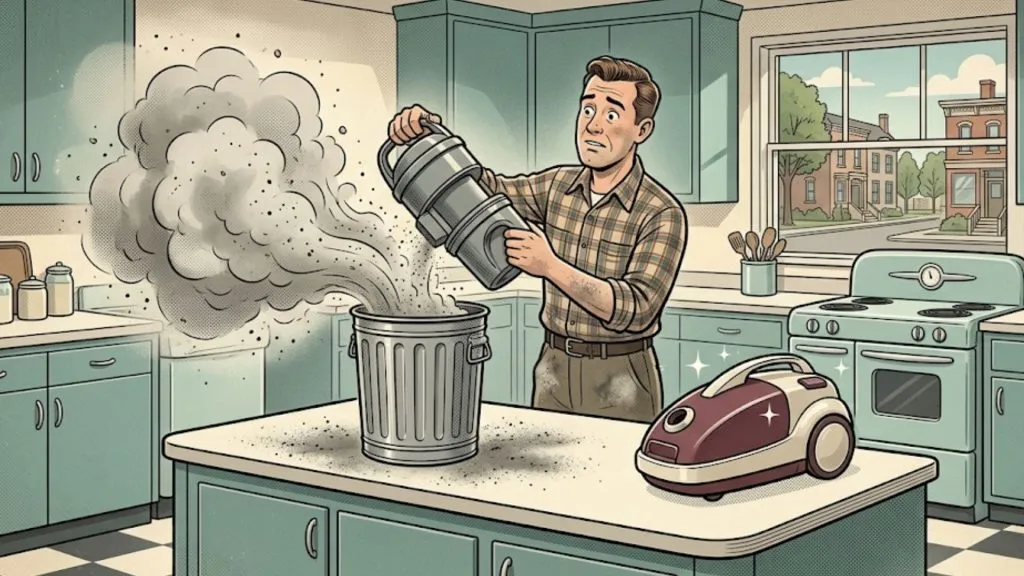
You had to strike the rug repeatedly to physically force the deeply embedded dirt out of the wool fibers. You would be standing in a massive, choking cloud of dust for hours on end. It was exhausting, dirty, and largely inefficient. The world was absolutely desperate for a better way to clean.
Thomas Edison and the Dawn of the Electric Sweeper
The true turning point for domestic cleaning didn’t start with a vacuum at all; it started with a light bulb.
When Thomas Edison and his contemporaries began electrifying cities in the late 1880s and early 1890s, they changed the fabric of society. However, early electrical grids were built for one specific purpose: illumination.
According to the Library of Congress, Edison’s massive push to electrify the nation meant that early homes were wired only for overhead ceiling lights.
The standard wall outlet that we take for granted today simply had not been invented yet. If you were wealthy enough to have electricity in your Tuscarawas County home in 1905, you had light sockets in the ceiling, and absolutely nothing on the walls.
So, when the very first electric vacuum cleaners were invented, how did people power them?
They screwed them into the ceiling!
The “Light Fixture” Vacuum
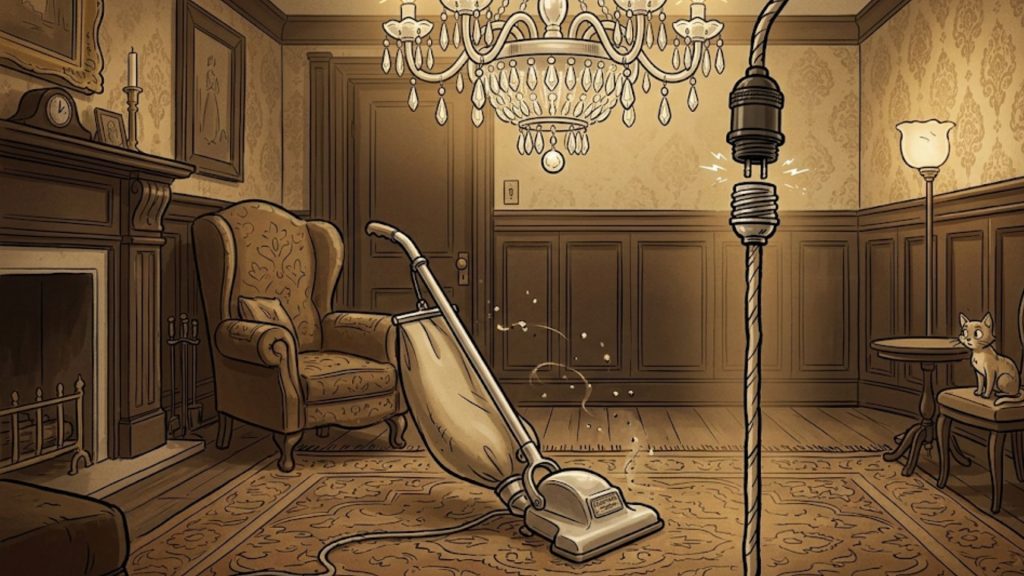
This is one of the most fascinating artifacts of early appliance history. Early electric vacuums came with incredibly long, thick, cloth-wrapped power cords that ended in a threaded light bulb base.
To vacuum your parlor, you had to drag a heavy wooden chair to the center of the room. You would climb up, unscrew a hot glass lightbulb from your chandelier, and screw your vacuum cleaner’s power cord directly into the live ceiling fixture.
You would then vacuum your rug while a heavy, live electrical cord dangled from the ceiling, swaying dangerously around your head. It was wildly inconvenient and honestly quite dangerous by modern safety standards, but it was still vastly superior to beating rugs in the dirt!
The Ohio Connection: Hoover and the Rotating Brush
While early electric suction machines existed, they were mostly massive, horse-drawn contraptions or incredibly heavy domestic tanks that relied entirely on raw suction.
Raw suction is great for surface dust, but it doesn’t solve the problem of deeply embedded grit. To truly clean a heavy rug, you still needed to “beat” it.
The brilliant solution to this problem happened right in our own Ohio backyard.
In 1907, a janitor named James Murray Spangler from Canton, Ohio, was suffering from terrible asthma caused by the dust he swept up at work. Using a tin soap box, a sateen pillowcase, a broom handle, and an electric fan motor, he cobbled together a crude, upright electric sweeper.
But Spangler did something revolutionary: he added a rotating brush.
“It Beats As It Sweeps As It Cleans”
Spangler realized that if an electric motor could turn a fan for suction, it could also turn a belt. He used that belt to spin a wooden brush roll equipped with stiff bristles.
As the machine moved across the floor, the rapidly spinning brush physically struck the carpet fibers, bouncing the heavy, embedded dirt up into the air stream where the suction could catch it. It was the mechanical equivalent of beating a rug on a clothesline, but it happened automatically inside the machine.
Spangler patented his brilliant invention but lacked the funding to manufacture it. He showed it to his cousin, Susan Hoover. Her husband, William H. Hoover, was a successful leather goods manufacturer in New Berlin, Ohio (a town later renamed North Canton).
W.H. Hoover bought the patent, refined the design, and launched the Hoover Electric Suction Sweeper Company. The Ohio History Connection notes that this single decision transformed the regional Ohio economy and created a globally recognized brand that forever changed domestic life.
The Cost of Luxury: 1910 Economics
While the Ohio-built Hoover was a mechanical marvel, it was definitely not an impulse purchase.
In the early 1910s, an electric vacuum cleaner was a profound luxury item. It was a status symbol reserved for the wealthiest families in town. To understand just how valuable these early machines were, we have to look at the economic reality of the era.
Around this same time, Henry Ford was revolutionizing the automotive industry. By perfecting the moving assembly line, Ford was aggressively driving down the price of the Model T automobile, making it accessible to the middle class.
Let’s look at an astonishing cost comparison from circa 1910:
1910 Cost Comparison Table
| The Product | Approximate Cost (c. 1910) | Context for the Era |
| Ford Model T Automobile | $500.00 | A complete, drivable, motorized vehicle. |
| Electric Vacuum Cleaner | $90.00 | A single household appliance. |
| Average Hourly Wage | $0.22 per hour | It took over 400 hours of labor to buy a sweeper! |
When you realize that an electric vacuum cleaner cost nearly one-fifth the price of a brand-new automobile, you understand why people treated them with such incredible care.
These machines were major investments. They were built with solid cast aluminum, heavy-duty copper-wound motors, and solid wood handles. They were explicitly engineered to be repaired and passed down to the next generation, a true testament to the “Buy It For Life” philosophy that we still advocate for today.
The Door-to-Door Revolution
Because electric vacuums were so expensive and the concept of “electric suction” was so new, you couldn’t just put them on a shelf in a general store and expect people to buy them.
People needed to see the magic to believe it. This birthed the era of the door-to-door vacuum salesman.
Sharply dressed salesmen would travel through towns like Strasburg and New Philadelphia, knocking on doors. They would ask the homeowner to let them vacuum a small square of their “clean” rug.
When the salesman opened the cloth bag and dumped a massive pile of hidden, black dirt onto a white piece of paper, the homeowners were absolutely horrified—and immediately sold on the concept.
Sweeper Trivia: 4 Fun Facts from Cleaning History
Before we jump back to modern maintenance, let’s share a few of our favorite historical fun facts. We love discussing these tidbits with the customers who visit our Dover showroom!
- 1. Horse-Drawn Cleaners: Before portable electrics were invented, professional cleaning services used massive, gasoline-powered vacuums mounted on horse-drawn carriages. They would park outside a wealthy client’s home, run a 100-foot hose through the living room window, and loudly suck the dirt right out into the street.
- 2. The “Choking” Inventor: To prove that sucking dust was better than blowing it, early vacuum pioneer Hubert Cecil Booth tested his theory by placing his mouth over a plush velvet chair and inhaling sharply. He nearly choked to death on the dust, but he proved his theory worked!
- 3. 50-Pound Beasts: We often complain about carrying a 15-pound vacuum up the stairs today. In the 1910s and 20s, a standard residential electric sweeper made of cast iron, heavy copper, and thick wood could easily weigh upwards of 50 pounds!
- 4. The White House Sweepers: President William Howard Taft was famously responsible for bringing the very first electric vacuum cleaners into the White House. He ordered them shortly after his inauguration in 1909 to help the staff keep the massive presidential rugs pristine.
The Evidence of a Broken Sweeper (Then and Now)
Whether you are dealing with a 100-year-old antique Hoover or a modern, high-end SEBO, recognizing when your machine is failing is critical to protecting your investment.
Because early vacuums were so expensive, homeowners learned how to identify the warning signs of mechanical failure immediately. If you ignored a strange noise, you could destroy a machine that cost a month’s salary!
Here at John’s Sweeper Service, we still use these classic diagnostic techniques. Here is our quick-reference guide to the evidence of a broken sweeper:
| The Warning Sign | What the Evidence Means | Your Next Step |
| A Sharp Burning Smell | The brush is jammed, and the motor is melting the rubber drive belt. | Unplug immediately! Clear the jam and replace the belt. |
| Spitting Dirt Back Out | There is a massive clog in the hose, or the internal bag has ruptured. | Empty the bin, change the bag, and check the airways. |
| Loud Grinding Noises | The motor bearings are failing, or a hard object is destroying the fan. | Stop using it. This requires professional repair. |
| A Shower of Blue Sparks | The internal carbon motor brushes are completely worn down to the metal. | Turn it off! Bring it in for motor service immediately. |
| Zero Suction at the Floor | The brush roll is not agitating, or the base plate seal has completely failed. | Check the roller for hair tangles and test the belt tension. |
If your sweeper is exhibiting any of these symptoms, do not force it to keep running. Just like the machines of the 1910s, modern quality vacuums are fully repairable if you catch the problem early.
Honoring the Legacy of American Ingenuity
The evolution from beating rugs in the dirt to screwing a heavy motor into a ceiling chandelier to the lightweight convenience of modern sweepers is a truly incredible journey.
It is a story of problem-solving, brilliant engineering, and local Ohio history.
When you buy a high-quality vacuum today, you are benefiting from over a century of refined design. The heavy-duty metal brush rolls and bypass motors we see in the premium brands today are the direct descendants of Spangler and Hoover’s original, revolutionary ideas.
Experience History at John’s Sweeper Service!
You don’t just have to read about this fascinating history; you can see it with your own eyes right here in T-County.
We invite you to visit our storefront in downtown Dover. We are incredibly proud to host the area’s only comprehensive Vintage Vacuum Museum.
Come walk through our collection and see the massive cast-iron beasts of the early 1900s. Look at the original cloth-wrapped cords that used to plug into ceiling lights. Marvel at the gleaming, aerodynamic chrome “tanks” of the 1950s. It is a nostalgic, educational, and truly fun experience for the entire family.
While you are visiting, you can also take care of your modern cleaning needs. If your current machine is making a strange noise or has lost its suction, bring it along!
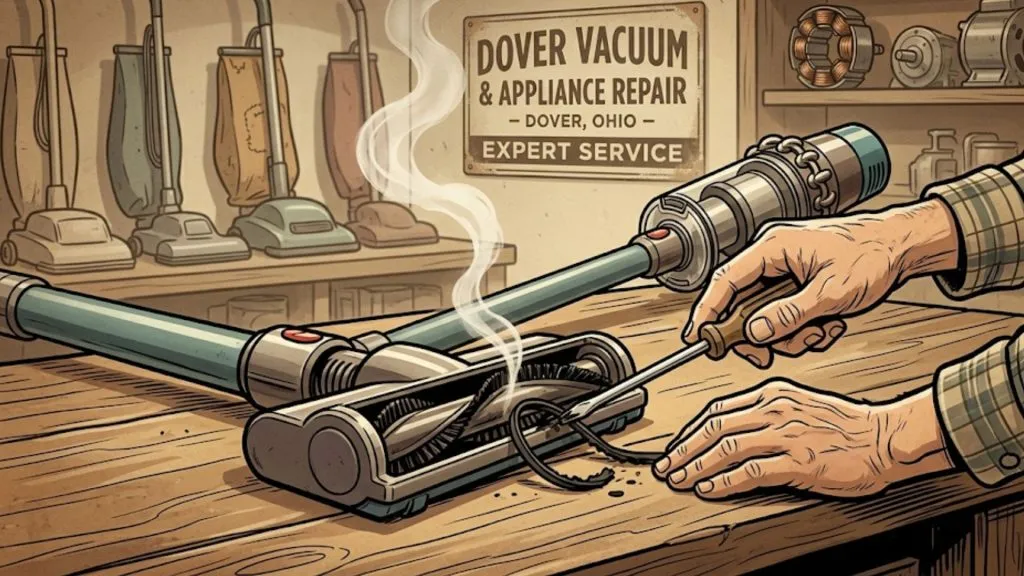
We offer expert residential vacuum repair for all major brands. Our technicians have the decades of experience required to diagnose and fix any issue, honoring the long tradition of keeping these essential household machines running at their absolute best.
Don’t settle for a disposable plastic machine when you can own a piece of quality engineering. Visit John’s Sweeper Service and our Vintage Vacuum Museum in Dover today!
John’s Sweeper Service & Vintage Vacuum Museum Downtown Dover, OH Call: 330-343-4092
Related reading: Chrome, Curves, and Convenience: The 1940s Post-War Sweeper Revolution | Museum Spotlight: The 1950s Hoover Constellation and the “Space Age” Sweeper