
When you manage a professional cleaning crew or a busy facility in Tuscarawas County, time is literally money.
Every minute your equipment is down is a minute your payroll is being wasted.
You rely on heavy-duty equipment to tackle massive jobs in hotels, schools, and offices. So, what happens when your commercial vacuum has no suction right in the middle of a crucial cleaning shift?
If a cleaner turns to you and says, “My vacuum lost power,” it can instantly derail your entire nightly schedule.
At John’s Sweeper Service in downtown Dover, we understand the incredible stress of equipment failure. We work with local business owners every single day who are frustrated when a powerful vacuum loses suction unexpectedly.
The good news? A loss of suction rarely means the machine is completely dead.
Whether you are a frontline housekeeper looking for a quick five-minute fix, or a seasoned facility maintenance mechanic ready to tear a machine down, we have you covered.
In this comprehensive vacuum cleaner troubleshooting guide, we will walk you through the exact steps we use on our own repair benches, broken down by DIY skill level.
The Evidence of a Broken Commercial Sweeper
Before you start dismantling your heavy-duty machine on an office floor, we need to diagnose the actual problem.
Is your machine simply clogged, or has it suffered a catastrophic mechanical failure?
Industrial machines are built like tanks, meaning they will often try to keep running even when a major component is failing.
Here is our quick-reference table to help you identify the issue and determine the required DIY skill level:
| The Warning Sign | What the Evidence Means | Skill Level | Your Immediate Action |
| High-Pitched “Screaming” Noise | The motor is suffocating. A massive clog is forcing the bypass fan to over-rev. | Beginner | Turn it off! Locate and remove the airflow blockage immediately. |
| Acrid, Burning Rubber Smell | The commercial brush roll is jammed, melting the heavy-duty drive belt. | Beginner | Unplug immediately! Clear the brush jam and install a new belt. |
| A High-Pitched Whistling Sound | A rubber gasket has failed, or the hose has a tear, causing a massive air leak. | Advanced | Inspect all seals and replace the damaged hose or body gasket. |
| Metallic Grinding Sounds | The commercial motor bearings are failing, or a hard object shattered the fan. | Professional | Tag the machine “Out of Service.” This requires a shop rebuild. |
| Machine Suddenly Dies | You tripped a thermal overload switch, or there is a break in the 50-foot cord. | Advanced | Let it cool down. If it won’t reset, test the cord continuity. |
If your machine sounds relatively normal but simply isn’t picking up dirt, you are likely dealing with an airflow restriction. Let’s start troubleshooting!
Level 1: Beginner DIY (The 5-Minute Housekeeper Fixes)
These steps require absolutely zero tools and no mechanical background.
Every single member of your cleaning staff should be trained on these basic techniques to prevent unnecessary downtime in your facility.
Step 1: The “Hand Test” Diagnostic
When troubleshooting vacuum suction loss, you must isolate the problem instantly.
Commercial vacuums have long hoses, thick wands, and massive floor heads. You need to know exactly where the blockage is hiding so you don’t waste time looking in the wrong place.
The quickest way to do this is the “Hand Test.”
- Detach the main flexible hose directly from the body or canister of the industrial vacuum.
- Turn the machine on.
- Place your hand flat over the intake port directly on the machine’s body.
If you feel an incredibly strong, skin-pulling suction at the base, the motor is perfectly healthy! Your blockage is entirely located in the hose, the wand, or the floor tool.
If the suction is weak at the base, your hose is fine. The problem lies inside the machine’s dirt collection or filtration system.
Step 2: Checking the Commercial Collection System
If your machine failed the Hand Test, your first suspect is always the dirt collection system.
Industrial vacuums move a massive volume of air. They also suck up a staggering amount of dirt. Even a massive 10-quart commercial backpack bag will fill up faster than you think.
When a bag gets more than two-thirds full, the dirt begins to compact. This compacted dirt acts like a brick wall, physically preventing air from flowing through the machine.
- Check the Bag: Do not just squeeze it; physically open the chamber and look. If the bag is firm to the touch, throw it away.
- Check the Intake Port: Commercial cleaners often suck up large debris like paper towels or food wrappers. These items frequently get stuck right at the opening where the dirt enters the bag, acting like a closed door.
Step 3: Commercial Filtration Failures
If the bag is empty but the suction is still incredibly weak, you are dealing with a choked respiratory system.
Industrial machines often have multiple, thick filters designed to protect the motor.
- Pre-Motor Filters: These sit between the bag and the motor. If a bag accidentally rips, this filter catches the dirt. If it is caked in dust, the motor is suffocating.
- HEPA Exhaust Filters: These massive filters trap microscopic allergens before the air leaves the machine. If you are cleaning drywall dust or fine powders, these micropores will clog almost instantly.
Always keep backup filters in your supply cart. A clean filter is the fastest way to restore a commercial machine to factory performance.
Step 4: Clearing Hose Blockages
If your machine passed the Hand Test, you know the problem is in the hose or the wand.
In a commercial environment, staff move quickly. They often accidentally suck up massive paper clips, zip ties, or clumps of sticky debris that get wedged sideways in the flexible hose.
- The Broom Handle Trick: For straight, non-electrified commercial hoses, detach the hose completely. Gently push a blunt, smooth wooden broom handle through the hose to force the blockage out.
- Check the Wand Joints: Blockages almost always occur where a wider tube narrows into a smaller tube. Disconnect all metal wands and look through them like a telescope toward a light source.
Level 2: Advanced DIY (For the Maintenance Mechanic)
If the beginner steps didn’t solve the problem, the issue is more complex.
These steps are designed for facility maintenance personnel or highly confident DIYers who are comfortable using basic hand tools and multimeters.
Advanced Step 1: Hunting for Vacuum Leaks (Gaskets and Seals)
A vacuum relies entirely on a sealed system to create suction. If air is escaping before it reaches the floor head, your suction will plummet.
Commercial vacuums are constantly slammed into walls and thrown into utility closets. Over time, the heavy-duty rubber gaskets that seal the machine together can warp, dry rot, or tear.
- Listen for the Whistle: Turn the machine on in a quiet room. If you hear a high-pitched whistling or hissing sound, you have an air leak.
- Check the Bag Door Gasket: Open the main compartment. Run your finger along the rubber gasket that lines the door. If it is flattened, cracked, or missing chunks, the vacuum cannot pull a proper vacuum.
- Inspect the Hose Cuffs: The plastic cuffs at the ends of the flexible hose frequently crack under stress. If the cuff is loose, you are losing 50% of your suction power right at the connection joint.
You will need to source specific commercial vacuum replacement parts to replace these proprietary gaskets.
Advanced Step 2: Diagnosing Seized Bearings
If your commercial upright vacuum has massive suction at the hose, but it still isn’t cleaning the carpet, you are likely dealing with a brush roll failure.
Beginners know to cut the hair off the brush roll, but an advanced DIYer needs to check the bearings.
To deep clean commercial carpets, you need heavy, aggressive agitation. If the brush roll bearings have rusted shut or seized from compacted grit, the brush will not spin, and the belt will continuously melt.
- The Spin Test: Remove the bottom plate and slide the heavy metal brush roll out of the machine. Hold the two end caps firmly in your hands and try to spin the wooden or metal center.
- The Diagnosis: It should spin freely and smoothly for several seconds. If it feels gritty, stiff, or completely locked up, the bearings are destroyed.
- The Fix: Depending on the brand, you can either pop the end caps off and press in new bearings, or you will need to replace the entire brush roll assembly.
Advanced Step 3: Electrical Continuity and Thermal Overloads
What if the vacuum just suddenly dies and refuses to turn on?
Before you assume the motor is dead, an advanced DIYer should check the power delivery system. Commercial vacuums are equipped with thermal overload switches to protect the motor from catching fire if it gets too hot (usually caused by a massive clog).
According to safety guidelines from the National Fire Protection Association (NFPA), electrical cords and switches on commercial equipment must be rigorously inspected for safety.
- The Thermal Reset: Let the machine sit unplugged for 45 minutes to completely cool down. Look for a small red or black reset button near the motor housing. Push it. If it clicks, you tripped the thermal switch.
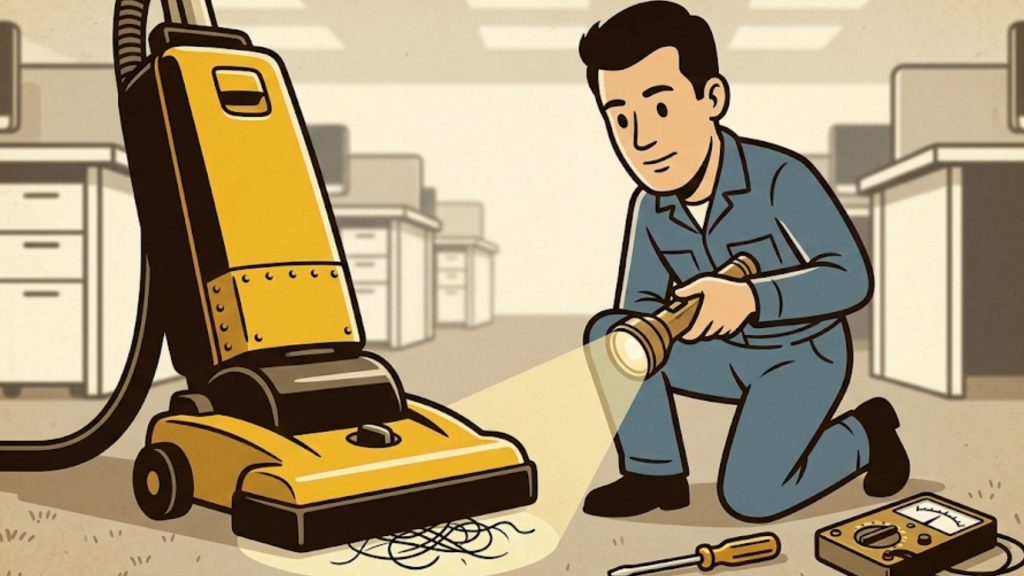
- Testing the Cord: Commercial 50-foot cords are constantly run over, slammed in doors, and pulled aggressively. Use a multimeter to test for continuity from the wall plug prongs to the switch terminals. A break in the cord is the most common electrical failure we see in T-County.
- Testing the Switch: If the cord is good, test the main power toggle switch for continuity. These heavy-duty switches often become packed with fine dust, preventing the electrical contacts from closing.
Proactive Commercial Maintenance Schedules
The absolute best way to fix an industrial vacuum is to never let it break down in the first place.
If you run a business in Tuscarawas County, we highly recommend implementing a strict preventative maintenance schedule for your cleaning staff:
- Daily (Beginner): Empty all bags before they reach capacity. Perform a visual inspection of the heavy-duty power cord for dangerous frays or exposed wires.
- Weekly (Beginner): Flip all uprights over and use a seam ripper to cut away any hair or string wrapped around the commercial brush rolls.
- Monthly (Advanced): Inspect all pre-motor and exhaust filters. Remove the brush roll, check the bearing health, and inspect all rubber gaskets for dry rot.
When to Call the Experts at John’s Sweeper Service
While many suction issues can be solved by your in-house maintenance team, commercial machines see an incredible amount of daily abuse.
If you have gone through this entire troubleshooting guide and your machine is still failing to perform, it is time to call in the local experts.
Attempting to rebuild a commercial bypass motor, replace an internal fan, or replace carbon motor brushes requires specialized tools and can easily void your expensive factory warranties.
If you need professional, rapid repair, look no further than John’s Sweeper Service in Dover, OH.
We are the trusted repair service for businesses all across Tuscarawas County. We understand that your business cannot wait weeks for a repair. We prioritize our commercial accounts, offering lightning-fast turnaround times and stocking a massive inventory of authentic industrial parts.
To learn more about how we partner with local businesses, read about our experienced team and our commitment to T-County.
Explore Cleaning History in Downtown Dover!
When you drop your commercial fleet off for servicing, we invite you to take a break from the daily grind and experience something truly unique.
Our downtown Dover storefront is incredibly proud to host the area’s only Vintage Vacuum Museum!
Take a fascinating walk through the history of the commercial cleaning industry. See the massive, heavy-duty cast iron machines of the 1920s that paved the way for the industrial sweepers your crew uses today. It is a nostalgic, educational experience right here in our hometown.
Don’t let a loss of suction slow your business down. For expert advice, fast commercial repairs, and honest service, visit John’s Sweeper Service today!
John’s Sweeper Service & Vintage Vacuum Museum
- Downtown Dover, OH
- Call: 330-343-4092
Related reading: Are Vacuums Worth Repairing?